Looking for Easy Maths Tricks for Kids to Boost Calculation Speed?
Maths Tricks for Kids can turn everyday calculations into quick, simple, and enjoyable challenges. From adding numbers faster to spotting multiplication patterns, these methods help children understand numbers instead of simply memorizing answers.
When kids practice fun maths tricks through games and real examples, they can build confidence, improve mental maths skills, and become more comfortable solving problems without always reaching for a calculator. The key is to teach each trick step by step and let children practice it in a fun way.
The 5 Best Maths Tricks for Quick Calculations
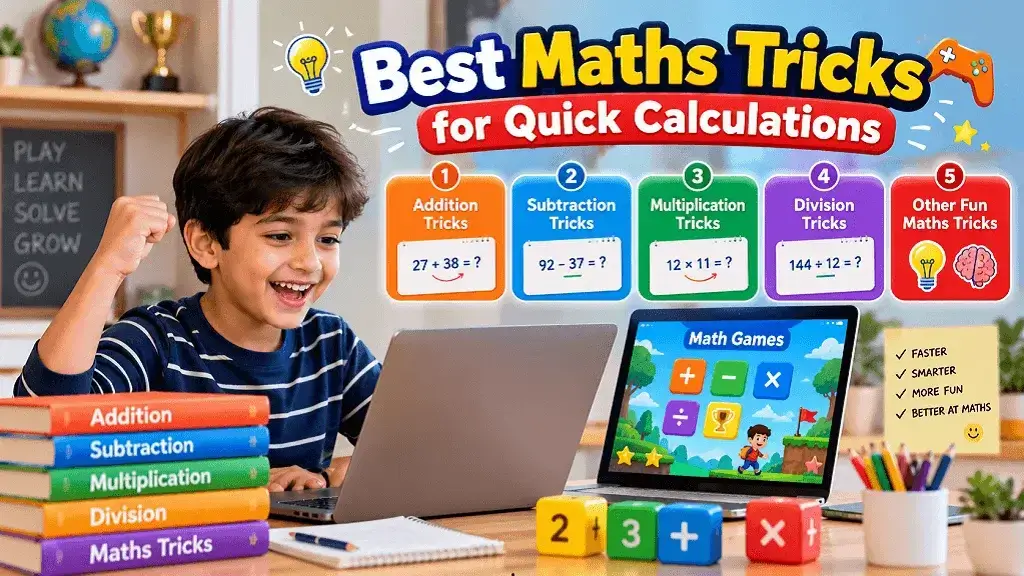
These simple methods are useful for classroom practice, homework, and mental maths games.
| Maths Trick | Simple Idea | Useful For |
|---|---|---|
| Addition | Break numbers into easy parts | Faster sums |
| Subtraction | Think about the reverse addition | Checking answers |
| Multiplication | Use number patterns | Mental calculations |
| Division | Look for digit patterns | Quick checking |
| Counting | Group numbers together | Faster counting |
1. Addition Tricks
Break Numbers Down & Round Up
Breaking Addition numbers into smaller parts makes addition easier.
For example:
38 + 27
Think of 27 as 20 + 7.
38 + 20 = 58
58 + 7 = 65
Another useful method is rounding. For 49 + 26, think of 49 as 50, calculate 50 + 26 = 76, then subtract 1.
This teaches children that numbers can be rearranged to make calculations easier.
2. Subtraction Tricks
Use Reverse Addition
Subtraction becomes easier when kids think about the distance between two numbers.
For example, instead of calculating 73 – 68 directly, ask:
68 + ? = 73
The answer is 5.
This reverse addition method is especially useful when the two numbers are close together.
3. Multiplication Tricks
Multiply Large Numbers & The Rule of 6s
Large multiplication for kids problems can often be separated into smaller calculations.
For example:
14 × 6
Break 14 into 10 + 4.
10 × 6 = 60
4 × 6 = 24
60 + 24 = 84
For Cool Math 4 Games multiplication by 6, children can also remember that 6 × an even number produces an even result, while patterns become easier to spot with regular practice.
The goal is not to replace multiplication facts. It is to help children understand how those facts work.
4. Division Tricks
How the Digits Reveal a Lot
Some numbers have simple divisibility patterns.
For example:
- A number ending in 0, 2, 4, 6, or 8 is divisible by 2.
- A number whose digits add up to a multiple of 3 is divisible by 3.
- A number ending in 0 or 5 is divisible by 5.
- A number ending in 0 is divisible by 10.
Try 123. Its digits add up to 1 + 2 + 3 = 6, so 123 is divisible by 3.
These patterns help children check calculations quickly.
5. Other Fun Maths Tricks
Quicker Counting Methods
Grouping objects can make counting much faster.
Instead of counting 20 objects one by one, group them into sets of 5:
5 + 5 + 5 + 5 = 20
Children can use this approach with toys, coins, blocks, pencils, or game points. It connects maths with things they already see every day.
Mind-Blowing Maths Tricks Your Kids Will Love
Some maths tricks feel like magic because children can predict an answer by following a simple number pattern.
1. The “Twin Numbers” Magic
Choose a two-digit number and add its twin.
For example:
23 + 23 = 46
Here, doubling the number is the same as adding it to itself. You can turn this into a quick challenge: give your child a number and ask them to double it mentally. Start with small numbers and gradually increase the difficulty.
2. Double, Double, Half, Then Times 10
This trick can make certain multiplication problems easier.
For example, to calculate 25 × 16, you can use:
25 × 16 = 25 × 8 × 2
Since 25 × 4 = 100, children can use related doubling and halving patterns to simplify calculations. The important lesson is that multiplication can often be transformed into smaller, familiar steps.
Why Are Math Tricks Important for Your Child’s Success?
Math tricks can help children develop mental maths, number sense, calculation speed, logical thinking, and confidence. They encourage kids to recognize patterns and find easier ways to solve problems instead of treating every question as a completely new challenge. With regular practice, simple techniques such as rounding, breaking numbers apart, doubling, and grouping can make everyday calculations feel easier and more enjoyable.
When used correctly, Math Games for Kids should support core maths learning rather than replace it. Children still need a strong understanding of place value, arithmetic operations, multiplication facts, fractions, and problem-solving. A good way to build these skills is to spend a few minutes each day practicing mental maths, introduce one new trick at a time, and begin with easy examples before moving to harder calculations.
You can also connect maths to real-life situations, such as counting money, sharing objects, comparing prices, or working out scores during games. Adding fun challenges through Cool Math 4 Games can give children more opportunities to practice without making learning feel like extra homework. Most importantly, encourage your child to explain why a maths trick works, because understanding the method helps build stronger mathematical thinking and long-term confidence.
How Cool Math 4 Games Can Help Kids Master These Tricks?
Cool Math 4 Games can make maths practice feel more like play than homework. Interactive maths games can give children repeated opportunities to work with numbers, patterns, logic, and problem-solving.
The advantage of game-based practice is that children can learn by doing. Instead of solving one worksheet and stopping, they can try another challenge, learn from mistakes, and apply the same idea again.
Best Cool Math 4 Games to Make Learning Fun
Look for games that involve:
- Addition and subtraction challenges
- Multiplication practice
- Number patterns
- Logic puzzles
- Mental maths
- Counting challenges
- Strategy and problem-solving
A strong Cool Math Games experience should give children clear goals, simple controls, immediate feedback, and challenges that gradually become harder.
How Can You Effectively Teach Kids Mathematical Tricks?
Start with one technique and explain the reason behind it. Then solve two or three examples together before asking your child to try independently.
Use questions such as:
“Can you find an easier way to solve this?”
“What number pattern do you notice?”
“Can you check your answer another way?”
You can also turn practice into a short family challenge. Give your child five questions and let them explain which trick they used for each answer.
Most importantly, do not focus only on speed. A child who understands why a trick works has learned a useful mathematical skill. Speed usually improves with regular practice.
Final Thoughts
Maths Tricks for Kids are most useful when they make numbers easier to understand, not when they are treated as shortcuts to memorize. Start with simple addition, subtraction, multiplication, division, and counting strategies, then introduce more challenging patterns as your child becomes confident.
With regular practice and playful learning through Cool Math Tricks Games, children can turn everyday number problems into fun challenges while building stronger mental maths and problem-solving skills.
FAQs
At what age should kids start learning math tricks?
Children can begin using simple maths strategies as soon as they understand basic numbers and addition. Around ages 5 to 7, simple counting, doubling, grouping, and addition strategies can be introduced through play. More advanced mental maths tricks can be added as their number skills develop.
Are math tricks better than traditional learning?
Math tricks and traditional learning serve different purposes. Tricks can make calculations faster and more interesting, while traditional learning builds foundational concepts. The most useful approach combines both.
Can maths tricks improve mental maths skills?
Yes. Regular practice with number patterns, doubling, rounding, and decomposition can help children become more comfortable calculating mentally. The results depend on consistent practice and whether the child understands the underlying maths.
Should parents focus on speed when teaching maths tricks?
Speed should not be the main goal. Accuracy and understanding should come first. Once a child understands a method, repeated practice can naturally make calculations faster.
Can games help children learn maths tricks?
Yes. Educational maths games can provide repeated practice with numbers, patterns, logic, and problem-solving. Games can also make practice more engaging when they provide clear goals and immediate feedback.
Featured Games — Play Without Leaving This Page
Click any card to play instantly — no download, no sign-up required.
 Brick Breaker
 Awesome Tanks 2
 Run 3 – Temple Scientist
 Ben 10 Alien Run
 Football Bros
 Math Playground
 Red Ball 4
 Planet Clicker
 Tap Tap Racing
 Block Blast
 Tiny Fishing
 Tetris Master
 Loaf Clicker
 Snowrider
 Ultimate Trivia Quiz
 Candy Clicker
 Drift Boss Supercar
 Dino Game
 Math Duel
 Low’s Adventures 3
 Math Challenge For Kids
 Cookie Clicker
 Snake Game
 Math Trivia
